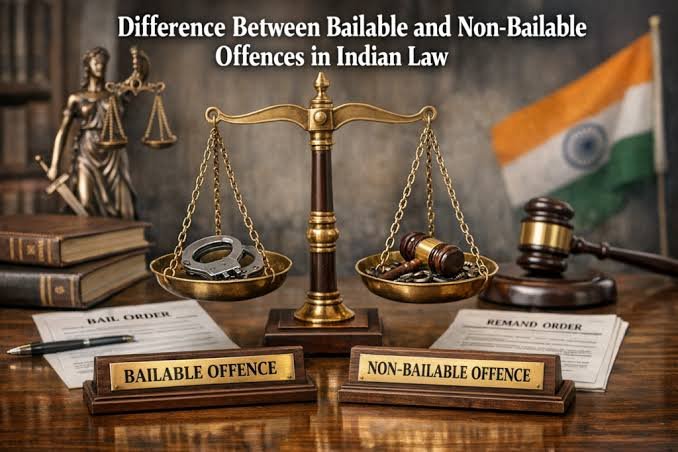
Introduction
Get an FIR filed against you, and the very first question your lawyer will ask isn’t “did you do it” — it’s “what section is this under.” Why? Because that decides everything about your next few days, sometimes weeks. The bailable vs non-bailable offence classification is one of those things that sounds like dry legal terminology until it’s your relative sitting in a police station and nobody’s explaining it clearly.
So let’s actually explain it clearly.
What Makes an Offence “Bailable”?
A bailable offence is one where bail is a matter of right, not a favour the court decides to grant. If you’re arrested for a bailable offence, the police officer or the court is legally bound to release you on bail if you’re willing to furnish it.
Quick answer: In a bailable offence, bail is your legal right, and the police or magistrate must grant it once you provide the required surety — no judicial discretion needed, unlike non-bailable offences.
Examples include simple hurt (Section 115(2) BNS, earlier Section 323 IPC), public nuisance, and defamation in many cases.
What Makes an Offence “Non-Bailable”?
Non-bailable offences are generally more serious — murder, rape, dacoity, offences under stringent laws like the NDPS Act. Here, bail isn’t automatic. It’s entirely at the discretion of the court, and the accused has to actually convince a judge that bail is warranted.
I’ve noticed clients get genuinely confused thinking “non-bailable” means “no bail at all.” That’s not true — it just means bail isn’t a right, it’s a request the court can grant or refuse based on facts.
How Is the Classification Decided?
This isn’t something a police officer decides on the spot. The classification comes from the First Schedule of the Bharatiya Nagarik Suraksha Sanhita (BNSS), 2023 (which replaced the CrPC), where each offence is specifically marked as bailable or non-bailable, along with whether it’s cognizable or non-cognizable.
Generally, the severity of punishment guides this:
- Offences punishable with imprisonment under 3 years are often bailable
- Offences with imprisonment of 3-7 years vary case by case
- Offences punishable with 7+ years or life imprisonment are almost always non-bailable
Process for Bailable Offences
If you’re arrested for a bailable offence:
- The investigating officer must inform you of your right to bail
- You can be released on executing a bail bond, with or without sureties
- No need to approach a magistrate separately in most cases — the police station itself can process it
Process for Non-Bailable Offences
For non-bailable offences, things move differently:
- You (or your lawyer) file a bail application before the magistrate or sessions court
- The court examines factors like flight risk, seriousness of the offence, evidence tampering possibility, and criminal history
- Anticipatory bail can also be sought in advance under Section 482 BNSS if arrest is apprehended
[link to related guide on anticipatory bail process in India here]
Real-World Example
Picture a small shop dispute in Jaipur that turns into a scuffle, and one party files an FIR for simple hurt. That’s bailable — the accused walks out on bail within hours, typically. Now change the facts: the scuffle involves a weapon and causes grievous injury under a section that’s non-bailable. Suddenly the same dispute means the accused could spend days, sometimes weeks, in judicial custody before a bail hearing even gets listed.
Same fight, wildly different outcomes — purely because of how the offence gets classified.
Common Misconceptions People Have
- “Non-bailable means you’ll definitely go to jail.” Not true — courts grant bail in non-bailable cases too, all the time, depending on facts.
- “Bailable offences are never serious.” Also not quite right — some bailable offences still carry real consequences and criminal records.
- “You need a lawyer only for non-bailable cases.” I’d disagree with this one strongly. Even bailable offence procedures benefit from proper legal guidance, especially around bail bond terms and conditions.
[link to related guide on how to file a criminal complaint here]
FAQ
Is bail automatic in bailable offences? Yes, it’s a legal right. The police or court must grant it once the accused is willing to provide the required bond or surety.
Can bail be refused in a non-bailable offence? Yes, it can be refused if the court believes there’s a flight risk, evidence tampering possibility, or the offence is severe enough to warrant custody during trial.
What law classifies offences as bailable or non-bailable in India? The First Schedule of the Bharatiya Nagarik Suraksha Sanhita, 2023 (previously the CrPC), lists each offence’s classification.
Can a non-bailable offence later become bailable? The classification itself doesn’t change, but courts can still grant regular or anticipatory bail after examining the facts — the outcome isn’t automatic either way.
Do I need to appear before a magistrate for bail in a bailable offence? Usually not — the police station can process bail directly for bailable offences, though complications can sometimes require magistrate intervention.
Conclusion
Understanding bailable vs non-bailable offence rules isn’t just academic — it directly shapes how fast someone gets released, what documents are needed, and how much a lawyer’s early involvement actually matters. If you or someone you know ever ends up on the wrong side of an FIR, the very first thing to check, before panic sets in, is which category the offence falls under. That one detail decides the entire next 48 hours.